
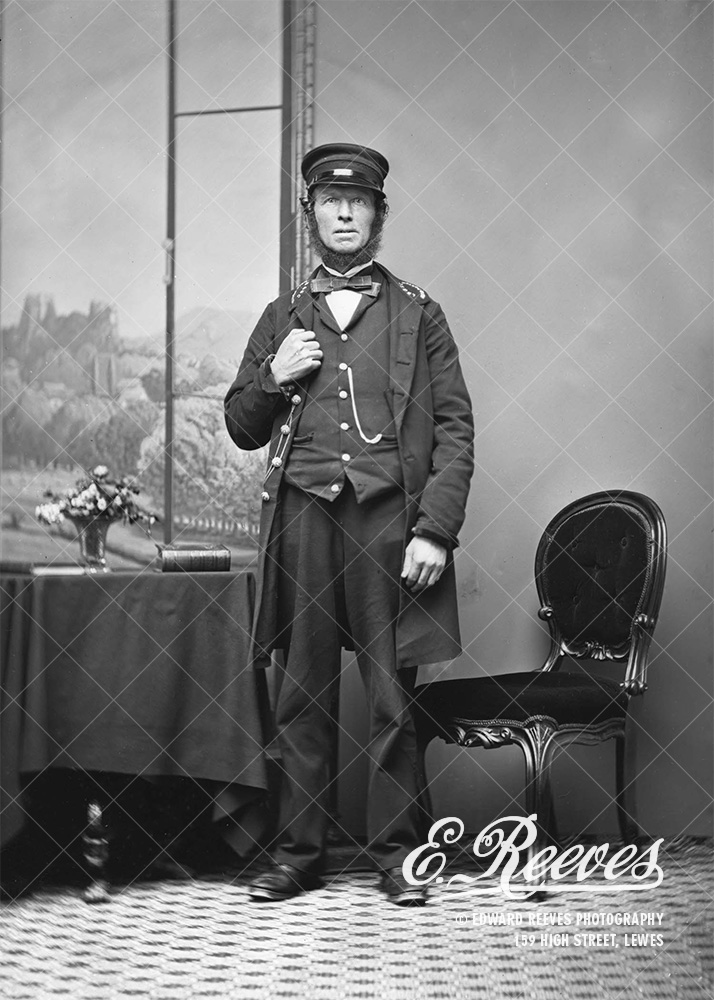
[Q4111] – Mr Isgar, Porter Railway Station, c.1864
PRESENCE OF MIND AND ESCAPE FROM IMMINENT DANGER
John Isgar, railway porter and occasional ticket collector at Lewes station, had an almost miraculous escape from death on Tuesday last, under circumstances in which his own admirable presence of mind would not have aided him, had his personal size been but a little larger than it really is.
It appears that on the day named, the train due at Lewes from Brighton at 2.35pm, arrived in due course, and the passengers alighted. It was then backed from the station platform to the upper platform, in order to get it on the proper rails for proceeding to Hastings. The attendance of some of the company’s servants is, of course, required at the upper platform, and their custom – though a dangerous one – is to ride on the outside of the carriage to it. Isgar, for that purpose, was about taking his position on the long step of one of the carriages, when he accidently slipt down in the direct way of the moving train. Isgar’s first impulse was to call to the driver to stop, but the word had hardly passed his lips, when he felt the inutility of doing so, and with a strong presence of mind and a promptitude more sudden than the danger which threatened him, he threw himself upon the ground beneath the moving carriages, so that the wheels on either side should miss his person. The ash-box of the engine, as is well known, is placed considerably below the floor of the ordinary carriages, and there was scarcely room for it to pass over without crushing the unfortunate man, whose only hope of prolonging his existence hung on so slender a chance.
The feelings of Isgar as he lay there, with the train passing over him, are beyond the powers of description, – the suspense while it lasted must have been agonising beyond conception. The station clerk and other parties who witnessed the occurrence were aghast under the horrifying impression that when the train had passed they should see the body of their coadjutor crushed and disfigured.
On comes the train – carriage after carriage passes above him – the approach of the dreaded ash-box is marked by the increasing heat – he feels it passing gently over his back – and he is safe. He rises with his jacket singed, and his forehead indented with an impression of the ground on which it had rested, indicating how imminent had been the risk he had run, and how closely he had pressed his body to the earth as the only hope of life.”
The Sussex Advertiser 3rd September 1850